How do I get points on the Score Card?
28/02-2018, 13:27(GMT+7)
Golf Tips
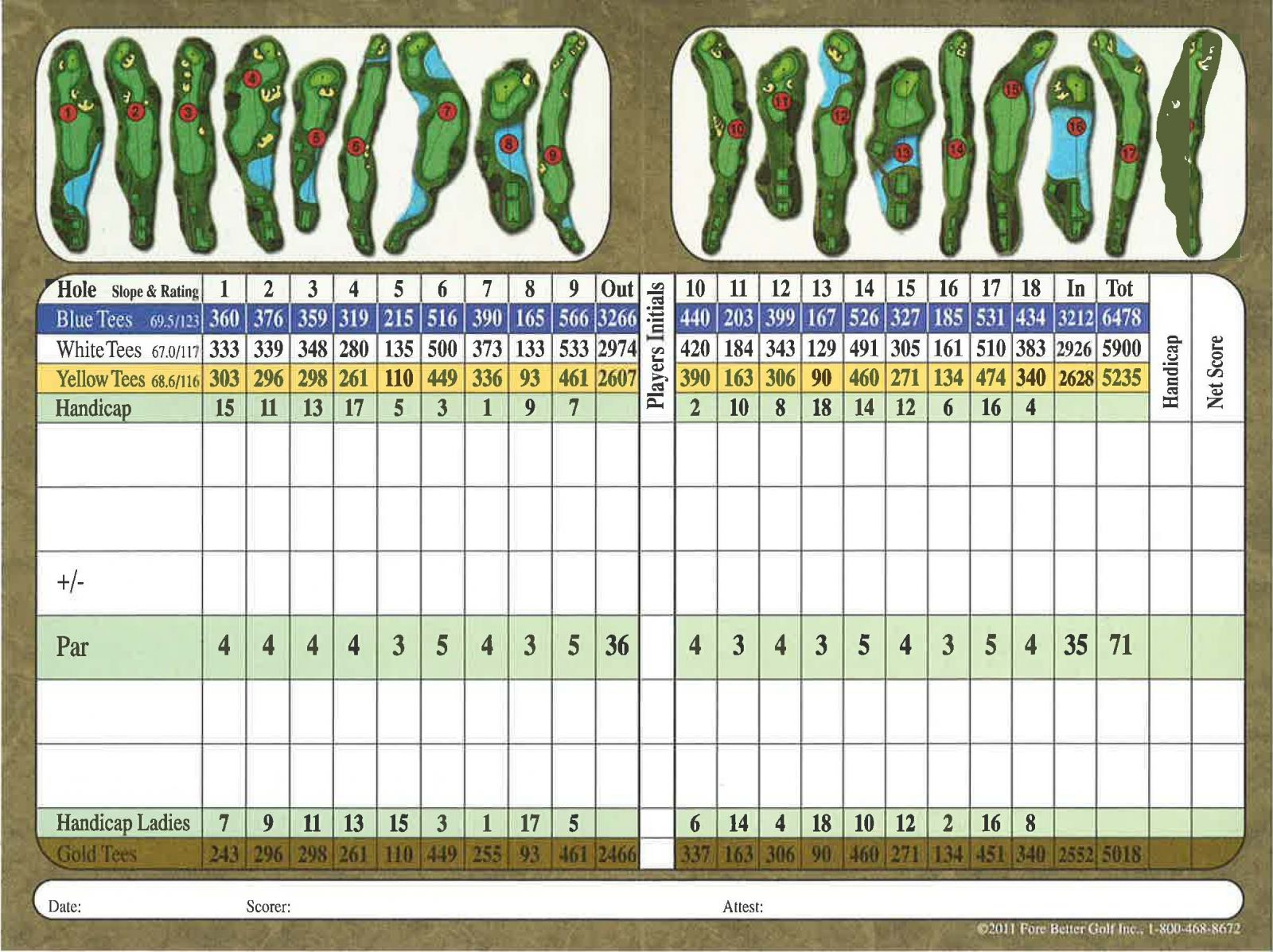
Yesterday, I compiled information about VHandicap - Vietnam Handicap Calculation System from VGA(the newest and most popular scoring application today). However, the use of this application is still not widespread. Many golf courses still use the traditional method of recording scores on scorecards. People think it's a simple task, but in reality, not every golfer knows how to record scores. This is especially true for beginners, who will certainly be confused. Even those who have been playing golf for a while still have advanced ways to write scores. Filling in the scorecard is the responsibility of each player in each golf game. Because the score you record reflects your performance and Your playing skills. Other players can also check and compete with you for scores. Intergolf has compiled instructions for recording scores on the Scorecard. First, here are five steps to the score recording process: Step 1: Write your name and the names of 3 friends you play with on the scorecard. Each name on a separate line. If you are playing in a handicap event, remember to ask your friends for their handicap and fill in the blank with their handicap. Ready on the scorecard.
Step 2:
Each time you finish a hole, record your score on the scorecard. Obviously, you know your score, but it's also a good idea to count your strokes to help you play. After each hole, ask for their score to compare with your count. If there's no discrepancy, record your score on the scorecard. If so, tell your playing partner that you counted a different score. Otherwise, it depends on whether your playing partner can convince you that you were the one who miscounted. Step 3: After 9 holes, add up the total score for each player. Write it down on the scorecard. Tell each person their score after 9 holes. Since you recorded the score for each hole immediately after each round, there shouldn't be any... The margin of error is small. Step 4: After the round ends, add the total score of the last 9 holes and add it to the total score of the previous 9 holes. This is the gross score of all 18 holes. Step 5: Subtract the handicap for each player. If player A scores 88 points after 18 holes, with a handicap of 12, then player A's net score is... 76. This final score will be compared with the total handicap scores of other players in the qualifying round.
Note: Please maintain a calm attitude and perspective when recording scores. Most players are honest in reporting their scores. Avoid unfortunate incidents such as scuffles and arguments on the court. Please be A cultured golfer.
Next, 10 different ways to write scores on a scorecard from basic to more complex:
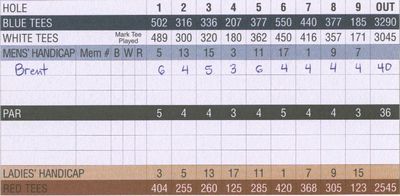
1. Writing a basic Stroke Play score
The simplest way to write a score is actually very simple: When playing stroke play, count the number of strokes you take to complete the hole, and write that number in the corresponding hole score on the scorecard. At the end of each half of the 9 holes, add up the total number of strokes and fill in the score. After the round, to know the score for all 18 holes, just add the two numbers together.
(We only took pictures of the first 9 holes on the scorecard to see the numbers; the following images will be the same.)
2. Play Stroke Play, indicating a birdie score and bogey
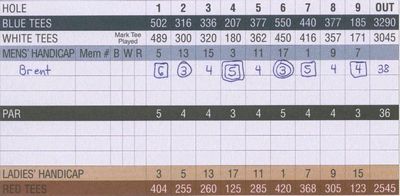
Some players have noticed that on professional golf broadcasts and on some websites that update players' scorecards, these scorecards have holes that don't have numbers or points written on them, but instead display circles or squares.
 />
/>
A circle represents a point below par, and a square represents a point above par. Any point not circled or squared is a par point.
We don't really like this scoring method because the scorecard looks messy. Especially for beginners and golfers with medium to high handicaps, this method is quite meaningless. Because If you're in this group of golfers, you rarely score a birdie, and sometimes you might not even get a par. Your scorecard will be full of numbers in the squares. But because this is how the PGA Tour writes it, many golfers prefer to write it this way. Again: the circle represents a birdie; if two circles are circled, it means an eagle or better. The square represents a bogey, and if two squares are circled, it means it's a double-bogey or worse.
3. Play Stroke Play and Track Your Personal Statistics
Many golfers like to track their statistics while playing to see how they're progressing. The statistics on the scorecard are usually fairway hits, GIR, and number of putts per hole.
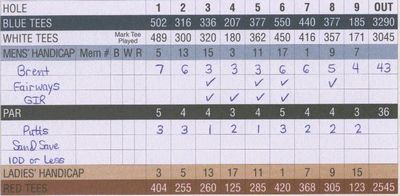
You can list these metrics below your name on the scorecard, with fairways and greens simply ticked. The number of putts per hole is simply counted and recorded. (Note: According to PGA Tour standards, only balls that land on the putt surface count as putts. If your ball is not on that surface but is on the edge and you use your putter to hit it, that shot does not count as a putt. This distinction is necessary for statistical purposes.) There are two more types of statistics... We should also keep an eye on bunker saves and the number of strokes used to close the 100 yards. Bunker saves are: one shot out of the bunker, then one putt. The score on the hole doesn't matter. Even if you shoot 9 on a hole, if the last two strokes are the save and the putt we just mentioned, then You've still reached your goal, so check the "Sand save" box for that hole.
There's no "100 yards" line on the illustrated scorecard, but like putting, this is a counting number. Count the number of strokes it takes to get the ball within 100 yards of the green. That's the counting area, and Many golfers find that they improve a lot by focusing on this 100-yard stroke count.
4. Stroke Play, Using Handicap
In the illustration there are two ways to write a scorecard when using stroke play handicaps. The above method is the more common, at least for golfers with low HDC. (The illustration below is an example of someone with a high HDC).
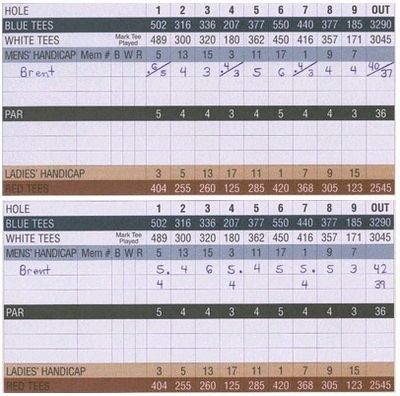
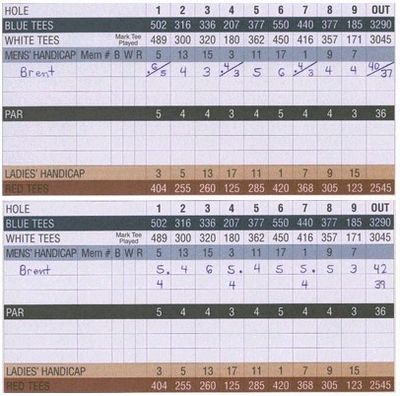
Remember:when talking about the field or scorecard, it is We're talking about the course handicap, not just the player's handicap. For beginners reading this, understand that "getting one stroke" or "getting more strokes" means the course handicap allows you to reduce your score by one stroke or more on specific holes. Always start by marking the holes where you get one stroke. Place a small dot inside the hole where the course handicap applies. (On the scorecard, there is a row labeled “Handicap” that will also tell you which holes you will receive strokes on. If your course handicap is 2, the strokes you receive are marked 1 and 2. If it is 8, the strokes are marked 1 to 8.) If you write your scorecard using the format above, use slashes to divide the boxes.
Just write your scores on the scorecard as normal. Your gross score (the actual score you play) is written in the upper half of the box. Then, for each hole where strokes are taken, write the net score (the actual score minus the handicap) in the lower half of the gross score.
When adding up the total score, also write the gross score in the upper half of the box and the net score in the lower half.
5. Stroke Play, course handicap greater than 18
This is the scorecard when the course handicap is 18 or more, with This means you'll get strokes on every hole, sometimes even two strokes on a single hole.
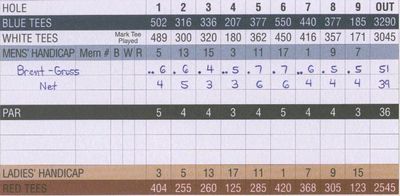
In this case, since you'll have to rewrite both the gross and net scores for each hole, to keep the scorecard clean and easy to read, use the "diagonal" method to distinguish between gross and net scores within the same hole. The rule remains: the gross score is half a hole. above, net score in the lower half.
Note that we still mark the scorecard with dots before the match starts, to represent the number of strokes received on each hole.
6. Play Stroke Play, on the scorecard there is a column "Handicap"
The illustrations above are all taken of the first 9 holes of the course, and the following image is The second half of the 9 holes.
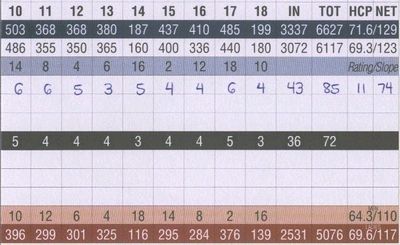
Look at the row above - do you see a column that says "HCP"? It means "handicap", of course everyone knows that, and if there is an HCP column on the scorecard then you can skip the dots, slashes and Write down your two scores in the same box as above.
If there is a handicap column printed on your scorecard, simply write your course handicap in the appropriate box (as illustrated, “11”). Write down your actual score (gross points) on each hole during the round, then add up your strokes at the end of the round.
In the illustration above, the total strokes is 85, and your course handicap is 11. Subtract 11 from 85 – simple, easy – and that’s it! you have a net score of 74.
7. Play Match Play
When playing match play with another golfer, you will mark your scorecard to indicate the relative position of the match. Think of it this way: the match starts “all square” (tied) because neither golfer has won any hole yet. So we will write “AS” which means “all square” as long as when the game is tied.
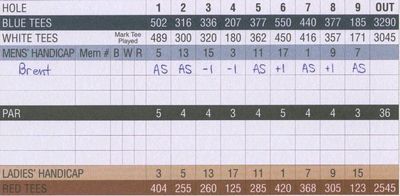
When someone wins a hole, you will write on the scorecard -1 if you lost that hole, +1 if you won that hole. That is, respectively, you are 1 hole behind, or 1 hole ahead. If it is a tie, it is again “AS”. But if you are 1 hole ahead and win the next hole, at this time the scorecard will read “+2” (more than 2 holes in a match).
If you halve (tie points) for several holes in a row, you will still write the scores for the holes the same. For example, if you are up by 1 hole at Hole 5, then on the scorecard write +1 in the box for Hole 5. Play the next 5 holes and still halve, then from holes 6 to 10 write “+1” on the scorecard, because you are still up by 1 hole.
This way of writing points also applies when playing match play in groups. For example, match play with handicaps will have in the next section.
8. Play Match Play vs. Par or Bogey (with handicap)
Match play vs. par or bogey describes a match in which you are not playing against a fellow golfer, but against par or bogey. In the illustration, it is a par play. That is: if you score par, you halve the hole; if you score birdie, you win the hole (because you score under par); if you bogey, you lose the hole (because you beat par). This is This is a great way to play if you're playing alone.
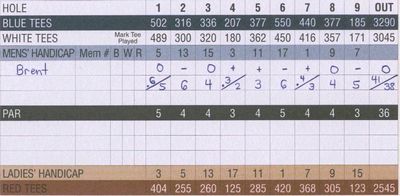
Common in match play vs. par, or match play vs. bogey is to use a system of pluses, minuses, and zeros to denote holes won, lost, or tied, respectively. You can use this system to denote your match play scorecard for every match, if you prefer to use AS, +1, and -1, then that's it. mentioned above.
Write 0 in the score if the hole is a halve (draw), add a (+) sign if you win the hole, and a (–) sign if you lose the hole. At the end of the round, count the number of plus and minus signs to get the final result (if you have 2 more plus signs than minus signs, you win a par or bogey with a result of more than 2).
Note that we have including the second row on the scorecard above, shows that this vs. par match used handicaps. The same technique for using handicaps as illustrated for stroke play is used above. When using handicaps in a match, the net score (the score minus the strokes awarded) on the hole awarded determines whether you win or lose the hole.
9. Stableford System
The Stableford System is A scoring system in which golfers earn points based on their score relative to par on each hole. The Stableford system is a great scoring system for recreational golfers, as there are no negative scores – a double bogey or worse is worth zero, but everything else earns you points. (This system is different from “Modified Stableford&rdquo&rdquo&rdquo&rdquo&rdquo&rdquo&rdquo&rdquo&rdquo&rdquo&rdquo&rdquo&rdquo&rdquo&rdquo&rdquo&rdquo&rdquo&rdquo&rdquo&rdquo&rdquo&rdquo&rdquo&rdquo&rdquo&rdquo&rdquo&rdquo&rdquo&rdquo&rdquo&rdquo&rdquo&rdquo&rdquo&rdquo&rdquo&rdquo&rdquo&rdquo&rdquo” is the number of strokes you take to complete a hole. The second row is the Stableford points earned on that hole. At the end of each nine holes, add up the total Stableford points, and at the end of the 18th hole, add up the two points from each half of the nine holes to get the total Stableford score.
The point values used in Stableford are specified in the Rules of Golf, Rule 32.
10. Stableford system using handicaps
For Stableford using handicaps, start by writing the scores on the scorecard in the same way you would for stroke play using handicaps (as shown in the illustration, the first line, using dots and slashes).
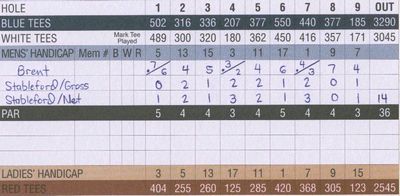
Add another line to the scorecard and name it “Stableford-gross”, add a third line labeled “Stableford-net”. After each hole, calculate your Stableford score based on your gross and net strokes, respectively, and write that score in the appropriate box. After each nine holes, add up your net Stableford score, then at the end of the round, add the two numbers from each half of the nine holes together to get your net Stableford score.
If you prefer, you can use just two lines – The first line shows the strokes, the second line shows both the Stableford-net and Stableford-gross scores. In this case, on the Stableford line, use a slash to divide the score box of the hole where you will gain strokes (similar to the stroke play score on the line above).
Source: various sources